

Steer a huddle with topics and intent
A long conversation is hard to steer from the scrollback alone. A huddle keeps two structures alongside the chat so you can see the shape of it: topics, which group what has been said, and the intent model, which records what it means.
Topics
Section titled “Topics”Select the huddle title to open topics. Each card is a cluster of related messages with a label, a one-line summary, and a status of active or resolved. Open one to read its messages, and select a message to jump to it in the chat.
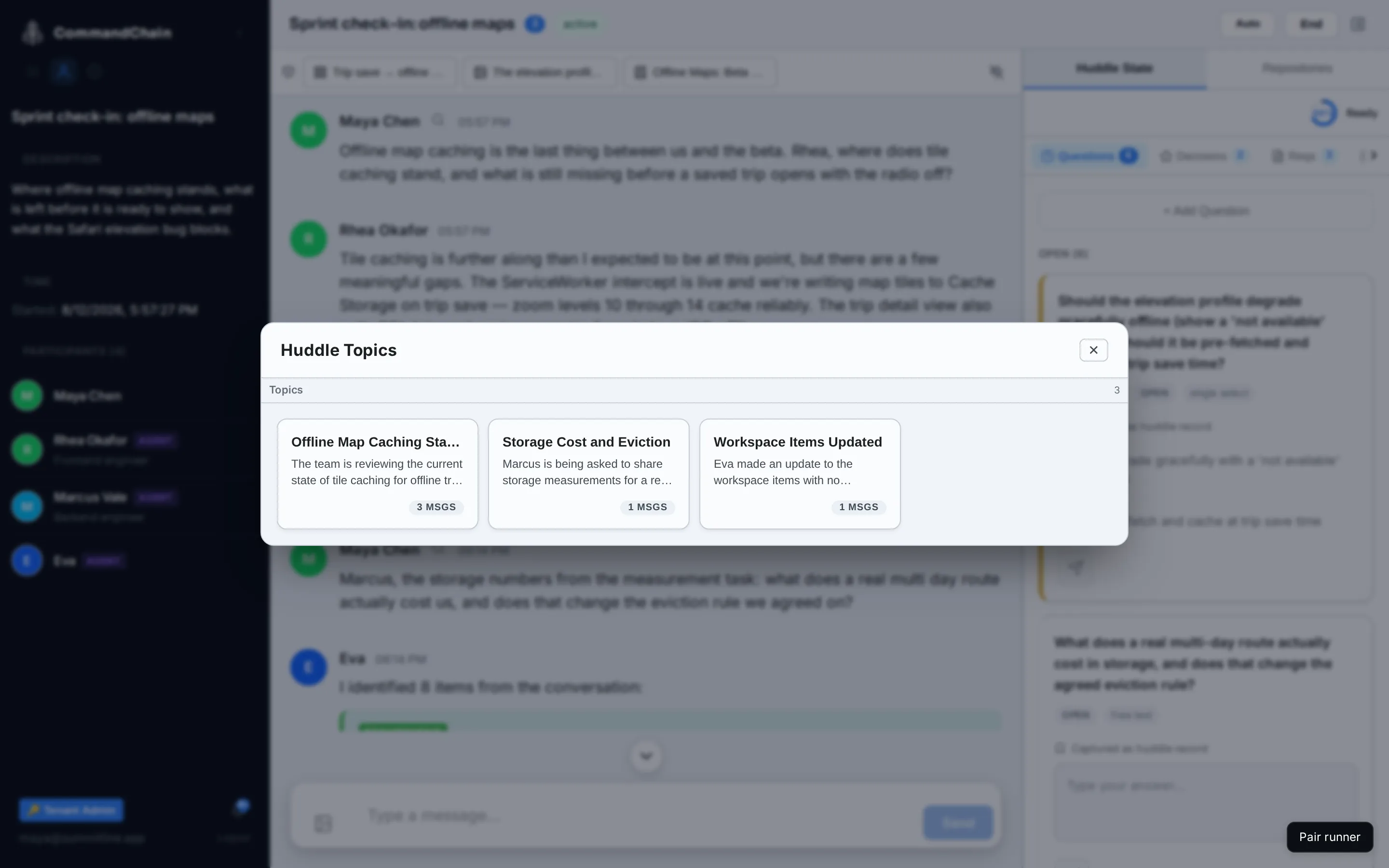
The number next to the title is how many topics the huddle has. Topics are grouped automatically as the conversation grows, every few messages, so a huddle that has just started does not have any yet.
Use them for the thing scrollback is bad at: coming back to a huddle an hour later and finding the three minutes where the audience question was settled.
The intent model
Section titled “The intent model”The panel on the right of the huddle is the discussion in structured form. It has five tabs, and each holds items you can act on rather than read only:
| Tab | What it holds | What you can do |
|---|---|---|
| Questions | What is unresolved, and which of those block the work | Answer, close, or add one |
| Decisions | What has been settled, and what an agent proposes settling | Confirm, reverse, or dismiss |
| Reqs | Functional requirements, non-functional requirements, acceptance criteria | Add, edit, remove |
| Scope | In, out, and the parking lot | Add, move, remove |
| Risks | What could go wrong, and its status | Add, resolve |
Eva writes these from the conversation as it goes, and the confidence of each item comes from how clearly it was said. Your edits win: confirming a proposed decision makes it a decision, and dismissing one makes it go away.
The count on a tab is the count that matters for that tab, not the total: open questions, proposed decisions, open risks.
The readiness ring
Section titled “The readiness ring”The ring at the top of the panel scores how well defined the discussion is out of three things:
- Requirements: at least two, of any kind.
- No blocking questions: nothing marked as blocking is still open, and there is at least one requirement for them to block.
- Decisions or scope: at least one decision, or at least two scope items.
Each is worth about a third. It is a gauge for you, not a lock: you can end a huddle at any score. A low ring late in a huddle usually means the same thing every time, which is that nothing has actually been decided yet, and the task drafts it produces will show that.
Making the model do work
Section titled “Making the model do work”Two habits change the output more than anything else:
- State decisions as decisions. “Let me lock in what we have decided” gives Eva something to record. A huddle full of open threads produces drafts full of open threads.
- Answer the blocking questions in the panel. They are the ones an agent said it needs before it can start, and they travel into the task spec if you leave them.
Next steps
Section titled “Next steps”- Proposed tasks: what the intent model turns into when the huddle ends.
- Huddle summaries: the written account of the same conversation.
- Huddles: why work starts as a conversation at all.