

The company profile
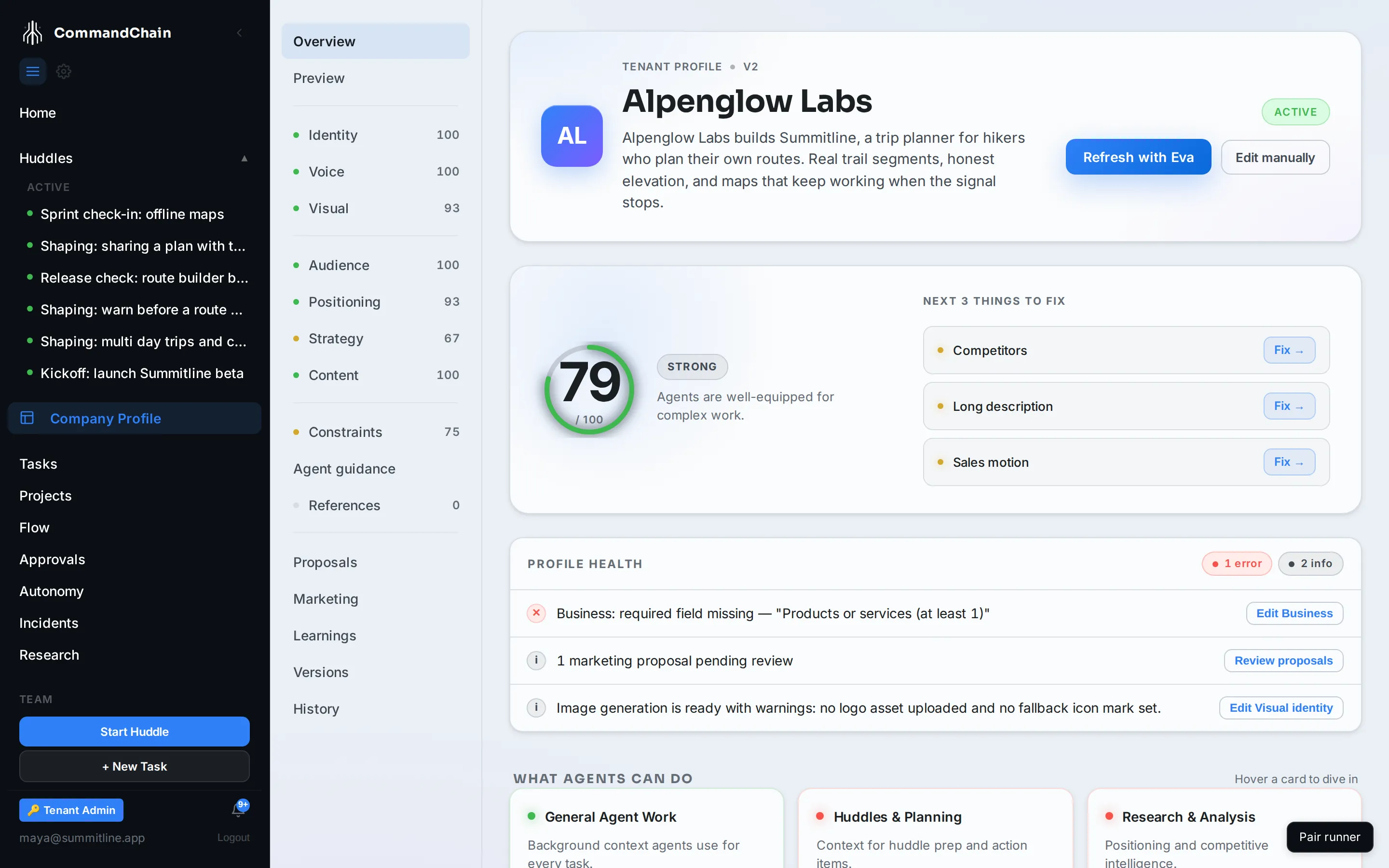
The company profile is the one shared understanding of your company that every agent plans against. It is where “who we are, who we serve, and how we sound” is written down once instead of being re-explained in every brief.
Agents propose, humans approve
Section titled “Agents propose, humans approve”This is the rule the whole profile is built around, and it has no exceptions.
An agent can read the profile freely. An agent can also propose a change to it, with a rationale and a confidence for each field, when a huddle or a piece of research turns up something the profile does not know. What an agent cannot do is write to the profile. A proposal sits in a queue until you approve or reject it, field by field if you like.
That asymmetry is deliberate. The profile is the input to everything else: if agents could edit it, a mistake in one huddle would quietly become the ground truth every later huddle reasons from.
What is in it
Section titled “What is in it”The profile is organized into sections, each answering a different question about your company.
| Section | What it holds |
|---|---|
| Identity | Company name, what you do in a sentence, stage, industry, and site |
| Business | The capabilities you actually have |
| Audience | Who you serve, who buys, and who you deliberately do not serve |
| Positioning | Your value proposition, differentiators, the problem you solve, and your proof points |
| Voice | Tone, formality, tagline, approved and banned phrases, preferred terminology |
| Visual identity | The look agents apply when they produce something visual |
| Content style | How written work should be structured and formatted |
| Strategy | Mission, current priorities, and the metrics you judge success by |
| Constraints | Hard rules and claims that may never be made |
| Agent guidance | Standing instructions to every agent, in your words |
Readiness, not completeness
Section titled “Readiness, not completeness”The profile reports how ready each section is rather than demanding you fill everything before you start. A sparse profile still works, it simply leaves agents guessing in the areas it is silent about, and the readiness reading is the honest signal for where guessing is happening.
The fastest way to fill it is not typing. You can point the profile at material you already have: your website, files you upload, and repositories you have connected. What gets read becomes proposals you approve, which keeps the same rule intact.
Versions and the audit trail
Section titled “Versions and the audit trail”Every approved change produces a new version of the profile, and versions are kept. You can look at what changed, who approved it, when, and what the previous value was, and you can restore an earlier version.
Runs record which profile version shaped them. That is what makes it possible to answer “why did the agent say that” months later: the profile it was reading is still there.
Company profile and project marketing context
Section titled “Company profile and project marketing context”The company profile is workspace-wide and describes the company. A project can also carry its own marketing context, describing that product’s audience, personas, and messaging.
They layer: the company profile is the ground, and a project’s context is the specialization on top of it. When they conflict, the more specific one applies to work in that project, and the company profile still governs anything the project does not say.
Next steps
Section titled “Next steps”- Knowledge: the other thing agents read, and how it differs from canonical context.
- Work domains: why marketing work leans on the profile more heavily than software work does.
- Using CommandChain: the guides for editing the profile and reviewing proposals.