

Set budgets
Settings → AI Configuration → Budgets caps every run in your workspace. It needs the manage_model_policy permission.
A budget is not only money. It is four ceilings, because a run can go wrong in four ways: it can cost too much, take too long, read or write too much, or loop.
The tenant defaults
Section titled “The tenant defaults”| Field | Caps | Alpenglow |
|---|---|---|
| Soft cap | Spend that triggers a warning | $4 |
| Hard cap | Spend that aborts the run | $12 |
| Wall-clock timeout | Elapsed time per run | 1800 s |
| Max input tokens | Tokens read per run | 400,000 |
| Max output tokens | Tokens written per run | 120,000 |
| Max iterations | Agentic loops per run | 24 |
| Throttle threshold | Fraction of the hard cap where throttling starts | 0.8 |
Leave a field blank to inherit the system default. These apply to every run without a task-type override.
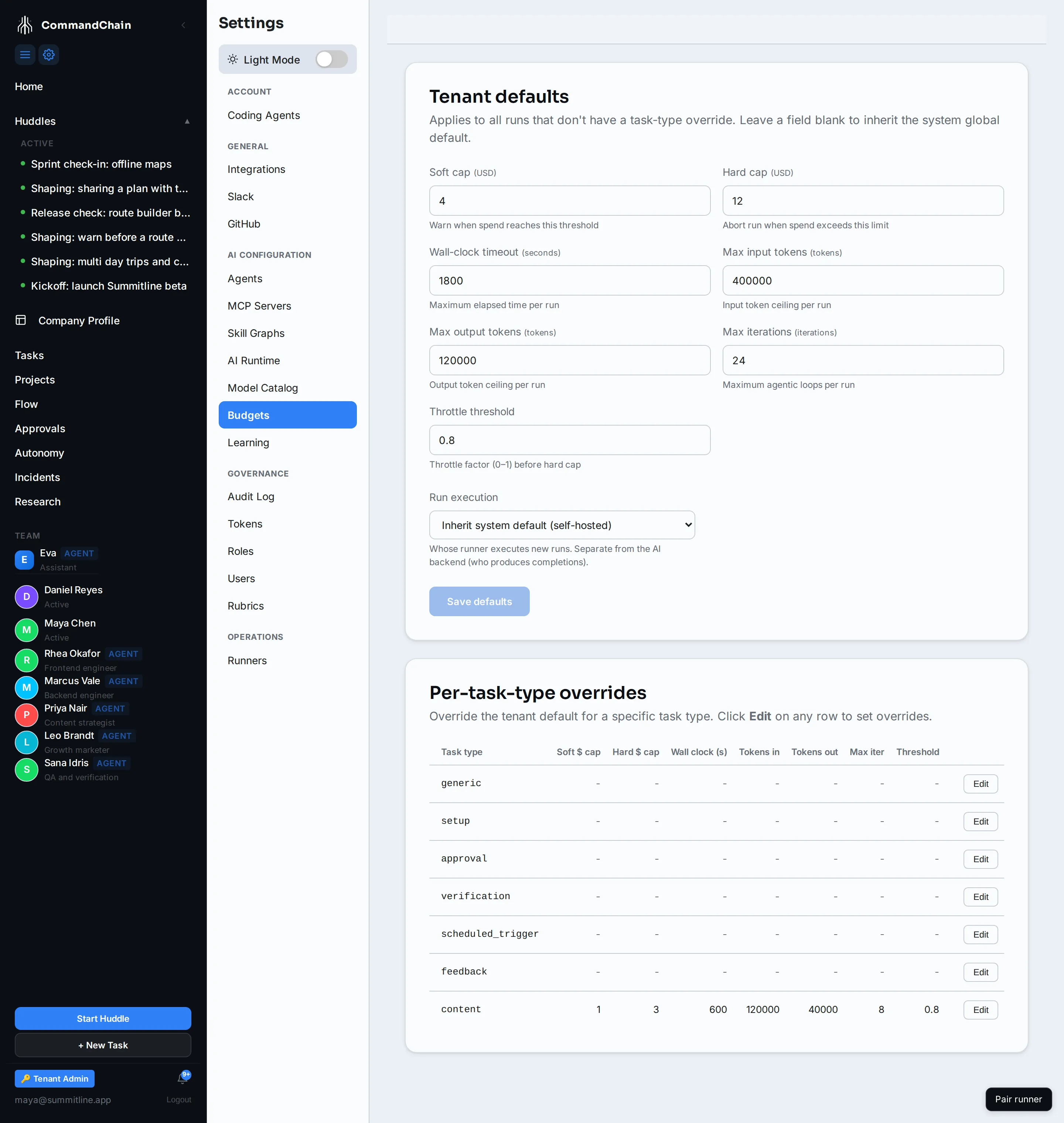
The gap between the soft and hard caps is the part worth thinking about. Too narrow and a warning is indistinguishable from an abort. Alpenglow’s 4 and 12 give a run room to finish after it has been noticed.
Running on CommandChain servers
Section titled “Running on CommandChain servers”Allow work to run on CommandChain servers sits with the budgets rather than with the AI runtime. CommandChain always tries your own connected runners first. When none can serve the configured runtime, work runs on CommandChain servers instead. Leave it off to keep all runner work on your own machines.
Selecting Run on CommandChain servers instead during setup turns this on. Managed runs need a login uploaded for managed runs; see connect an AI account for managed runs.
Per-task-type overrides
Section titled “Per-task-type overrides”The table under the defaults holds one row per task type. Click Edit to override any of the seven ceilings for that type; a dash means the row inherits.
Alpenglow overrides one type. Content runs get $1 soft, $3 hard, 600 seconds, and 8 iterations, because writing a launch post is a shorter and cheaper job than working through a code change, and a content run that has looped eight times is stuck rather than thorough.
Override a type when its work has a genuinely different shape. Overriding all seven for all seven types is a sign the tenant default is wrong.
What enforcement looks like mid-run
Section titled “What enforcement looks like mid-run”To an agent, a budget is not advice.
- At the soft cap, the run is warned and throttled: it keeps working with less headroom, and the warning is on the run.
- At the hard cap, the run stops. The attempt ends with the cap as its reason, and whatever it had produced is kept rather than discarded.
- At the wall clock, the token ceilings, or the iteration limit, the same thing happens, with that limit named.
A stopped run is not a lost one. It reports what it did, what it spent, and which ceiling it hit, and you can raise the budget for that run and let it continue.
Next steps
Section titled “Next steps”- Budgets: the concept, including agent-level budgets.
- The model catalog: the per-token prices these caps are spent at.
- The task workspace: where a stopped run reports the ceiling it hit.