
Initiatives and flow
An initiative is one tracked thread of intent. It starts where the intent was expressed, in a huddle, and it follows the same idea through drafts, tasks, runs, verification, shipping, and the marketing that announces it.
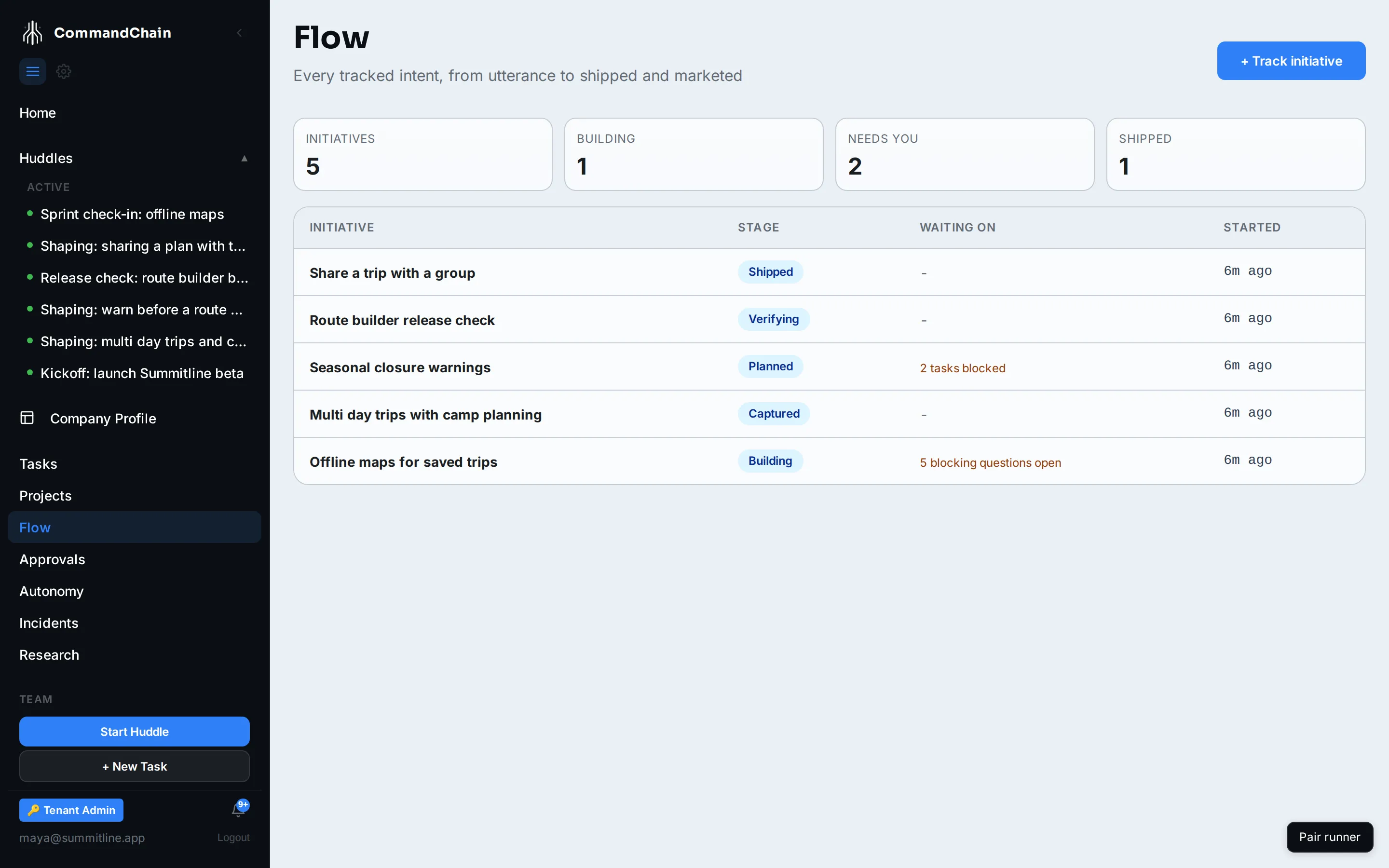
Flow is the view of every initiative at once: what is moving, what is stuck, and what is waiting for you.
The loop
Section titled “The loop”flowchart TB C([Captured: intent from a huddle]) --> P[Planned: drafts accepted] P --> B[Building: work in progress] B --> V[Verifying: checks running] V --> S[Shipped: every task done] S --> M[Marketing: something published] M -. what the results say .-> C
| Stage | What it means |
|---|---|
| Captured | Intent exists: objectives, requirements, decisions from the huddle |
| Planned | Drafts were accepted, or tasks exist |
| Building | Work is in progress. A task counts as built once its branch has merged into the huddle’s working copy |
| Verifying | Every task is built, and what is left is the huddle’s final check, the pull request, its checks, the review, and the ship verification |
| Shipped | Every task is done: for work in a repository, its branch has merged, and nothing is holding it |
| Marketing | Something derived from this work has been published |
The loop closes rather than ending. What the marketing results say becomes evidence for the next conversation, which is where the next initiative starts.
Stage is computed, never claimed
Section titled “Stage is computed, never claimed”An initiative has no status field anyone sets. Its stage is derived, every time it is read, from the state of its children: how many drafts were accepted, how many tasks have merged and how many are done, whether a verification gate has passed, whether an asset has actually been published.
That means the board cannot drift. Nobody has to remember to move a card, and nobody can move one to make a week look better than it was.
The receipt trail
Section titled “The receipt trail”Opening an initiative shows its journey: not a summary of the work, but the actual lineage, assembled from real links rather than guesses.
- The intent it came from: objectives, requirements, decisions, risks, and open questions.
- The drafts the huddle produced, and which of them you accepted.
- The tasks those drafts became, with their statuses.
- The runs that executed those tasks.
- The checks that scored the result, passed and failed.
- The assets published from that work.
- The approvals granted along the way.
Every one of those is a link you can follow. That is what makes the trail a receipt: you can go from a published post back to the decision in the conversation that caused it.
Where a link genuinely does not exist, the journey says so rather than inventing one. A stage with no lineage yet is shown as unlinked, and work that could not be attributed to any initiative is counted openly instead of being quietly assigned to the nearest one.
What is waiting on you
Section titled “What is waiting on you”An initiative also reports its blockers, which is what makes Flow a working view rather than a report:
- blocking questions still open from the huddle,
- tasks in a blocked state,
- approvals waiting for a decision,
- verification checks that failed.
Each of those has a person-sized action behind it, which is why Flow leads with them rather than with a percentage.
Next steps
Section titled “Next steps”- Huddles: where an initiative’s intent is captured.
- Runs and attempts: the execution the trail records.
- Using CommandChain: the guides for the Flow board, journeys, and approvals.